

 3 min
3 min
Monza Circuit, The Temple of Speed, the fastest F1 track-
Reading Time: 3 minutes
Monza Circuit “Autodromo Nazionale di Monza” in Italy, is universally known as the Temple of Speed home of the F1 Grand Prix.
Monza Circuit race track was built in 1922, third permanent circuit in the world after Brooklands and Indianapolis. The circuit’s biggest event is the F1 Italian Grand Prix, hosted there since 1949 in the first weekend of September.
There are other important race event during the year: in April, the Italian GT Championship, TCR Italian Series, Formula Regional European Championship, in May, classic cars championship, in July the FIA World Endurance Championship 6 Hours of Monza, European Le Mans Series 4 Hours of Monza, Le Mans Cup.
In September, FIA Formula 3 Championship, Porsche Supercup, International GT Open, Euroformula Open Championship, TCR Europe Series and in October, Italian GT Championship, Italian F4 Championship, ACCR Formula 4 Championship.
In 2020 and 2021 Monza hosted the World Rally Championship final round, ACI Rally Monza.
Tracks:
The site has three tracks – the 5.793 km (3.600 mi) Grand Prix track in use nowadays and other two not used, the 2.405 km (1.494 mi) Junior track and a 4.250 km (2.641 mi) high speed oval track with steep bankings.
Monza circuit is known for its high-speed, simplistic design and is currently the fastest track on the Formula One calendar. Formula 1 engines are at full throttle for nearly 80% of the lap and engine failures are common.
The circuit is generally flat but has a gradual gradient from the second Lesmos to the Variante Ascari. Due to the low aerodynamic profile needed, with its resulting low downforce, the grip is very low; understeer is a more serious issue than at other circuits; however, the opposite effect, oversteer, is also present in the second sector, requiring the use of a very distinctive opposite lock technique.
thecarspec tested the track with an Audi TT, here the onboard lap
Racing car set-up:
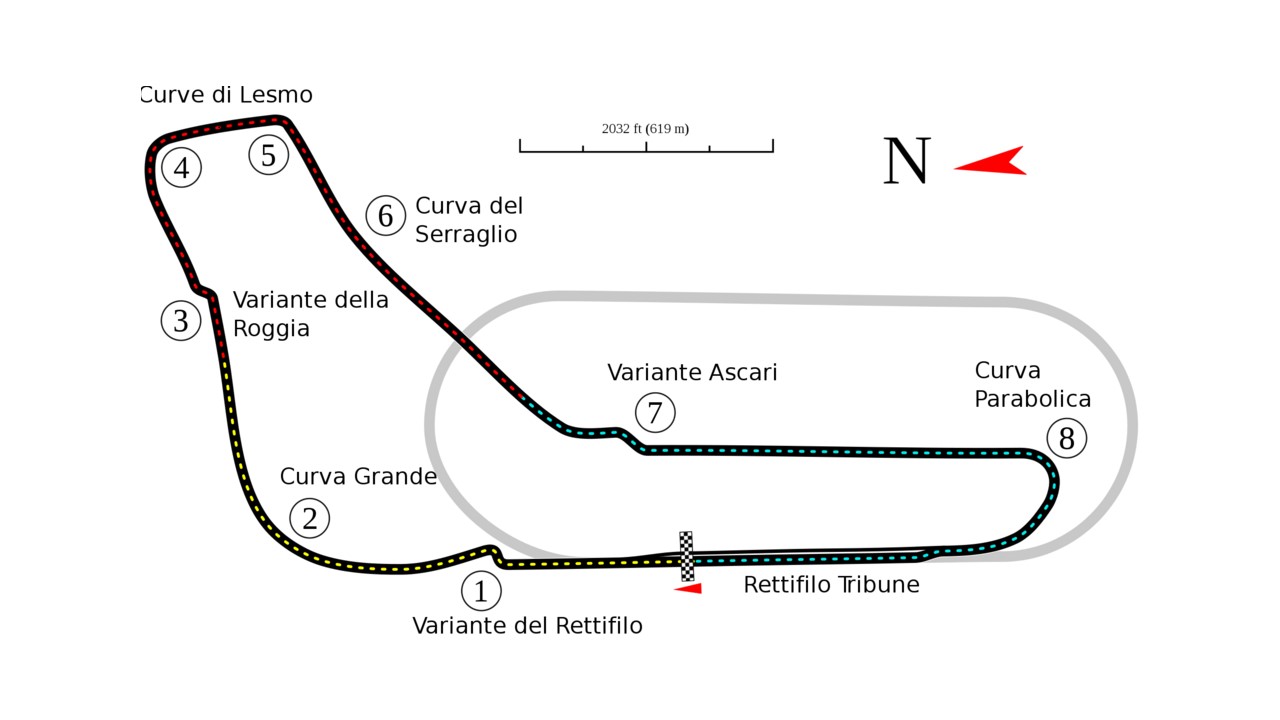
Formula One cars are set up with one of the smallest wing angles on the F1 calendar to ensure the lowest level of drag on the straights. There are only 6 corner complexes at Monza: the first two chicanes, the two Lesmos, the Ascari complex and the Parabolica, a total of 11 corners.
Direction of travel : clockwise
Cornering:
Cars approach the first corner at 340 km/h (210 mph) in eighth gear, and brake at about 120 m (130 yd) before the first chicane—the Variante del Rettifilo—entering at 86 km/h (53 mph) in second gear and exiting at 74 km/h (46 mph).
Conservation of speed through the first chicane is made possible by driving the straightest line, as a small mistake here can result in a lot of time being lost through the Curva Grande down to the Variante della Roggia chicane in eighth gear, at 330 km/h (210 mph). This chicane is probably the best overtaking chance on the lap, as it is the only one with the “slow corner, long straight, slow corner”; one of the characteristics of modern circuits.
The Curve di Lesmo are two corners that are not as fast as they used to be but are still challenging ones. The first is blind, entered at 264 km/h (164 mph) in sixth gear, while the second is a seventh gear entry at 260 km/h (160 mph).
The downhill straight down to Variante Ascari is very bumpy under the bridge.
The final challenge is the Curva Parabolica: approaching at 335 km/h (208 mph) in eighth gear, cars exit in sixth gear at 285 km/h (177 mph), accelerating onto the main start/finish straight.
Top Speeds and g-force:
Top speeds throughout the engine eras: 372 km/h (231 mph) during the mid-2000s V10 engine formula, 340 km/h (210 mph) in 2012 with the 2.4L V8 engines and up to 360 km/h (220 mph) since the 2014 1.6L turbocharged hybrid V6 engine.
Maximum speed was achieved by Pablo Montoya at 372,6 km/h at Monza test in 2005
Maximum g-force: 4.50G during deceleration.
Fastest Lap:
Max Verstappen on Red Bull RB21 recorded the fastest pole position lap at Monza in 2025, 1:18.792 at an average speed of 264.68 km/h (164.46 mph). This lap is average speed fastest in F1 history at the time.