

 4 min
4 min
AERODYNAMICS EXPLAINED FOR CAR ENTHUSIASTS
Reading Time: 4 minutes
Aerodynamics stands out as one of the most fascinating specs as it influences how a car slices through the air, how it grips the road, how it behaves at high speed, and even how efficiently it consumes fuel.
Thecarspec’s team has always been driven by a deep passion for cars, motorsport, and the engineering brilliance that transforms raw mechanical power into speed, stability, and emotion.
This article breaks down the fundamentals of automotive aerodynamics, focusing on the splitter, rear wing, diffuser, and other aerodynamic appendages. It also explores how Formula 1 cars—arguably the most advanced aerodynamic machines on Earth—use airflow to generate extraordinary performance.
What Aerodynamics Really Means in Automotive Engineering
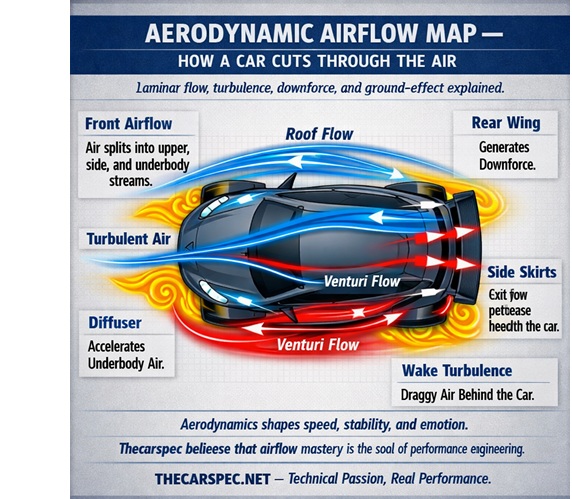
Aerodynamics is the science of how air interacts with a moving vehicle. When a car moves, it pushes air out of the way, creating forces that can either help or hinder performance. These forces include:
- Drag — the resistance that slows the car down
- Lift — the upward force that can make the car unstable
- Downforce — the downward force that increases grip
- Airflow management — directing air to cool brakes, engine, and radiators
In simple terms: Drag fights speed. Downforce creates grip. Airflow management keeps the car alive.
Modern performance cars—from the Porsche 911 GT3 to the Toyota GR Yaris, from the Corvette Z06 to the Ferrari 296 GTB—use aerodynamic components to balance these forces and deliver predictable, exhilarating driving dynamics.
The Front Splitter — The First Line of Aerodynamic Control
The front splitter is one of the most recognizable aerodynamic components. It’s a horizontal extension at the bottom of the front bumper, designed to “split” the airflow.
How the Splitter Works
A splitter creates a pressure difference:
- Above the splitter: air slows down and pressure increases
- Below the splitter: air accelerates and pressure decreases
This pressure imbalance pushes the front of the car downward, generating front downforce.
Thecarspec believes that the splitter is essential because front-end stability defines how confidently a car enters a corner. Without adequate front downforce, the car tends to understeer, losing precision and grip.
Real‑World Examples
- Subaru WRX STI S209 — uses a pronounced carbon splitter to increase front grip at high speed.
- Chevrolet Camaro ZL1 1LE — features a race-inspired splitter that dramatically improves track performance.
- Toyota GR Yaris Rally1 (WRC) — uses an oversized splitter to maximize front downforce on loose surfaces.
In all these cases, the splitter helps the car “bite” into corners, improving steering response and stability.
The Rear Wing — Turning Air Into Grip
If the splitter stabilizes the front, the rear wing stabilizes the back. It is arguably the most iconic aerodynamic device in motorsport.
How the Rear Wing Works
A rear wing operates like an upside-down airplane wing. Instead of generating lift, it generates downforce by:
- Forcing air to travel faster under the wing
- Slowing air above the wing
- Creating a pressure difference that pushes the car downward
The angle of the wing (called angle of attack) determines how much downforce and drag it produces.
Thecarspec thinks it’s important because rear downforce controls traction during acceleration and stability during high-speed cornering. Without it, powerful cars would struggle to put power down or remain stable at speed.
Real‑World Examples
- Porsche 911 GT3 RS (992) — features a swan‑neck wing that improves airflow under the wing, increasing efficiency.
- Nissan GT‑R Nismo — uses a large carbon wing to stabilize the rear at extreme speeds.
- Honda Civic Type R — its wing is tuned to reduce drag while still providing meaningful downforce for front‑wheel‑drive stability.
The Diffuser — The Hidden specification Under the Car
While splitters and wings are visible, the diffuser works quietly underneath the car. It is one of the most powerful aerodynamic tools available.
How the Diffuser Works
A diffuser expands the airflow exiting from under the car. This expansion reduces pressure under the vehicle, increasing downforce without adding much drag.
Key effects:
- Accelerates air under the car
- Creates a low-pressure zone
- Sucks the car downward
- Stabilizes rear-end behavior
Thecarspec believes that the diffuser is crucial because it generates “free” downforce—grip without the penalty of drag.
Real‑World Examples
- Ferrari 488 Pista — uses a sculpted diffuser to enhance rear stability.
- McLaren 720S — integrates the diffuser into the entire rear architecture for maximum efficiency.
- Corvette C8 Z06 — features a race-inspired diffuser that improves cornering balance.
Canards, Vortex Generators, and Other Aero Appendages
Beyond the main components, performance cars use smaller aerodynamic devices to fine-tune airflow.
Canards (Dive Planes)
Small fins on the front bumper that:
- Generate localized downforce
- Create vortices that seal airflow around the car
- Improve front-end grip
Used on cars like the Lamborghini Huracán STO and Nissan GT‑R Time Attack builds.
Vortex Generators
Small fins that energize airflow, often seen on rally cars and hot hatches.
They:
- Reduce drag
- Improve rear wing efficiency
- Stabilize airflow over the roof
The Mitsubishi Lancer Evolution IX made vortex generators famous.
Side Skirts
Help maintain low-pressure air under the car by preventing air from spilling in from the sides.
Aerodynamics in Formula 1 — The Pinnacle of Airflow Engineering
F1 cars are the most aerodynamically advanced vehicles ever built. Every surface, every curve, every millimeter is designed to manipulate air.
Ground Effect
Modern F1 cars (2022–2026 regulations) rely heavily on ground effect, using:
- Venturi tunnels under the car
- Massive diffusers
- Sealed airflow channels
This creates enormous downforce with relatively low drag.
Front Wing Complexity
The front wing:
- Directs air around the tires
- Creates vortices to energize airflow
- Balances front downforce
- Conditions air for the floor and sidepods
Rear Wing and DRS
The rear wing provides stability but also incorporates DRS (Drag Reduction System), which opens a flap to reduce drag and increase top speed during overtaking.
Beam Wing and Diffuser Interaction
The beam wing helps extract air from the diffuser, increasing ground-effect efficiency.
Why F1 Aerodynamics Matter to Road Cars
Many technologies trickle down:
- Diffuser design
- Wing profiles
- Vortex management
- Ground-effect principles
- Brake cooling ducts
- Underbody airflow optimization
Thecarspec thinks it’s important because F1 shows what is possible when aerodynamics is pushed to the limit. Road cars borrow these lessons to become faster, safer, and more efficient.
Aerodynamics and Fuel Efficiency
Aerodynamics doesn’t only matter for performance—it also affects fuel consumption.
A streamlined car:
- Requires less energy to maintain speed
- Reduces drag
- Improves highway efficiency
This is why EVs like the Tesla Model S, Mercedes EQS, and Lucid Air have extremely low drag coefficients.
Conclusion — Aerodynamics Is the Soul of Speed
Aerodynamics is not just about wings and splitters—it’s about shaping how a car feels, behaves, and performs. It defines stability, grip, efficiency, and confidence. Thecarspec believes that understanding aerodynamics helps enthusiasts appreciate the engineering brilliance behind their favorite cars.