

 3 min
3 min
Turbo vs Naturally Aspirated Engines
Reading Time: 3 minutes
The team at thecarspec.net has always believed that true automotive passion begins with the mechanical heartbeat of every car. And while suspensions define the precision, balance, and driving pleasure of sports cars, engines define the soul, the identity, and the emotional connection that enthusiasts feel every time they press the throttle. Today, we dive into one of the most iconic rivalries in automotive engineering: turbocharged engines vs naturally aspirated engines. This comparison blends technical depth, racing heritage, hybrid evolution, and the future of performance powertrains.
Thecarspec believes that understanding how turbo engines and naturally aspirated engines work is essential for anyone who loves cars, racing, and engineering. Thecarspec thinks it’s important because both engine types continue to influence modern hybrid systems and the advanced F1 2026 power units that represent the pinnacle of motorsport technology.
🔥 1. Naturally Aspirated Engines
A naturally aspirated engine (NA engine) breathes air without forced induction. No turbocharger, no supercharger — just atmospheric pressure feeding the cylinders. This simplicity creates a unique driving experience that enthusiasts often describe as “pure,” “connected,” and “alive.”
Why enthusiasts love NA engines
- Instant throttle response
- Linear power delivery
- High‑revving excitement
- Mechanical purity
- Iconic sound signatures
When you drive a naturally aspirated engine, you feel the RPM rise in a perfectly linear way. There’s no sudden torque spike, no boost surge — just a smooth crescendo of power that rewards precision and driver skill.
How naturally aspirated engines work
Air enters the intake manifold, passes through the throttle body, and fills the cylinders based solely on atmospheric pressure. The efficiency of this process depends on:
- Intake runner length
- Valve timing (VVT, VTEC, VANOS, etc.)
- Compression ratio
- Exhaust scavenging
- Camshaft profiles
NA engines rely heavily on mechanical optimization. Engineers tune every detail to maximize airflow, reduce friction, and increase volumetric efficiency.
Types of NA engines
- High‑revving NA engines (Honda K20, Ferrari V12)
- Large displacement NA engines (American V8s)
- Balanced daily‑use NA engines (Mazda Skyactiv)
These engines deliver a driving feel that many purists consider irreplaceable.
⚡ 2. Turbocharged Engines —
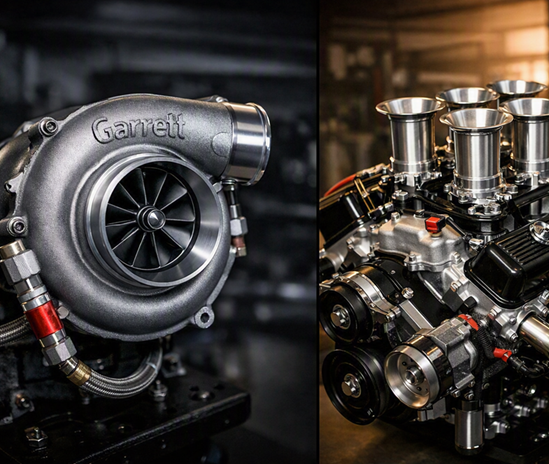
Turbocharged engines (turbo engines) use exhaust gases to spin a turbine, compressing air into the cylinders. More air means more fuel, which means more power — all from a smaller displacement.
Why turbo engines dominate modern performance
- Higher torque at low RPM
- Superior fuel efficiency
- Smaller displacement with big power
- Better emissions performance
- Massive tuning potential
Turbo engines have become the standard in performance cars, daily drivers, and hybrid systems because they deliver strong torque, excellent efficiency, and compact packaging.
How turbo engines work
A turbocharger has two main sides:
- Turbine — driven by exhaust gases
- Compressor — forces air into the engine
Key turbo components include:
- Intercooler
- Wastegate
- Blow‑off valve
- Turbo manifold
- Boost control system
- Charge pipes
Turbo engines are more complex than NA engines, but they offer unmatched flexibility and performance.
⚙️ 3. Turbo Lag vs Throttle Response
Turbo lag is the delay between throttle input and boost buildup. Modern engineering has dramatically reduced lag through:
- Twin‑scroll turbochargers
- Variable geometry turbines
- Electric turbo assist
- Hybrid torque fill
- Lightweight turbine wheels
NA engines still win in pure immediacy, but turbo engines have closed the gap to the point where most drivers barely notice lag.
🔋 4. Integration with Hybrid Electric Systems
Hybrid powertrains have changed the way engines are designed. Both turbo engines and naturally aspirated engines integrate differently with electric motors.
Turbo engines + hybrid systems
Turbo engines pair extremely well with hybrid electric motors because:
- Electric motors fill torque gaps
- Boost builds faster
- Regenerative braking improves efficiency
- Smaller engines reduce weight
- Electric torque smooths turbo lag
This is why most modern hybrid performance cars use turbocharged engines.
Naturally aspirated engines + hybrid systems
NA engines integrate with hybrids in a more “purist” way:
- Electric motors assist low‑end torque
- NA engines provide high‑RPM excitement
- Combined systems feel smoother and more natural
- Less complexity in boost management
Examples include Lexus hybrid V6/V8 systems, which blend smooth NA power with electric torque.
🏎️ 5. F1 2026 Power Units — The Ultimate Turbo‑Hybrid Evolution
Formula 1 in 2026 uses 1.6‑liter turbo‑hybrid power units that represent the most advanced combination of turbocharging and electrification in motorsport.
Key features of F1 2026 power units
- 1.6L V6 turbo engine
- Single turbocharger
- MGU‑K (kinetic motor generator)
- 50% electric power contribution
- Sustainable fuels
- Simplified energy recovery systems
These power units deliver:
- Instant electric torque
- High‑end turbo power
- Exceptional thermal efficiency
- Lightweight packaging
- Reduced complexity compared to previous seasons
F1 2026 proves that the future of performance is turbo‑hybrid, combining the efficiency of turbocharging with the instant torque of electric motors.
🏁 6. Turbo vs Naturally Aspirated — Which Is Better?
There is no universal winner — only different experiences.
Naturally Aspirated Engines
- Best throttle response
- Best sound
- Best emotional connection
- Best high‑RPM excitement
Turbocharged Engines
- Best torque
- Best efficiency
- Best hybrid integration
- Best real‑world performance
- Best tuning potential
The future belongs to turbo‑hybrid systems, but naturally aspirated engines will always remain icons of purity and passion.
Turbocharged engines and naturally aspirated engines represent two engineering philosophies that shaped automotive history. As hybrid systems evolve and F1 pushes the limits of technology, both approaches continue to influence how cars feel, perform, and excite enthusiasts.