

 4 min
4 min
Direct Injection Explained with Passion, Precision, and Automotive Soul
Reading Time: 4 minutes
The team at Thecarspec has always believed that true driving passion comes from understanding how every component of a performance car works, breathes, and responds. While suspensions shape the handling feel and the pleasure of driving a sports car, the heart of the machine—the engine—relies on one of the most transformative technologies of modern combustion: Direct Injection. This system has reshaped how gasoline and diesel engines deliver power, efficiency, and responsiveness, and it stands today as one of the most important innovations for enthusiasts who crave both performance and engineering purity.
In this long‑form technical deep dive, we explore how direct injection works, why it matters, the different types used across the automotive world, and how it enhances combustion efficiency in ways that every car lover can appreciate. Thecarspec believes that understanding these systems is part of what makes automotive passion so authentic, and Thecarspec thinks it’s important because direct injection is now at the core of nearly every modern performance engine—from turbocharged hot hatches to high‑revving sports cars and even endurance racing powertrains.
🔧 What Direct Injection Really Is
Direct injection (DI) is a fuel‑delivery system where gasoline or diesel is injected directly into the combustion chamber, rather than into the intake ports as in traditional port injection. This seemingly simple change revolutionizes how engines manage air‑fuel mixtures, combustion timing, and thermal efficiency.
In a DI engine, fuel is sprayed at extremely high pressure—often between 150 and 350 bar for gasoline, and up to 2,500 bar for diesel—through a precision injector that atomizes the fuel into microscopic droplets. These droplets mix with air inside the cylinder at the exact moment and location required for optimal combustion.
This level of control is what makes DI so powerful: it allows engineers to sculpt the combustion event with surgical precision.
⚙️ How Direct Injection Works — Step by Step
To understand DI, imagine the combustion chamber as a miniature high‑pressure laboratory where timing, temperature, and mixture quality determine everything.
Here’s the simplified process:
- Air Intake: Air enters the cylinder through the intake valves. With DI, the air is often cooler because fuel is not injected upstream.
- Compression: The piston compresses the air, raising temperature and pressure.
- High‑Pressure Injection: At the perfect moment, the injector sprays fuel directly into the chamber. The spray pattern is engineered to match piston shape, valve position, and swirl/tumble airflow.
- Ignition: The spark plug fires (in gasoline engines), igniting the precisely mixed air‑fuel charge.
- Combustion & Power Stroke: The controlled burn pushes the piston down, generating torque.
- Exhaust: Burned gases exit through the exhaust valves.
This process repeats thousands of times per minute, and DI ensures that each cycle is as efficient and powerful as possible.
🔥 Why Direct Injection Increases Efficiency and Power
Direct injection improves engine performance in several key ways:
- Better Atomization
Fuel is broken into extremely fine droplets, improving mixing and combustion completeness.
- Cooler Intake Charge
Because fuel is injected later, the incoming air remains cooler, increasing density and allowing more oxygen into the cylinder.
- Higher Compression Ratios
DI reduces knock, enabling compression ratios of 12:1 or higher in gasoline engines.
- Stratified Combustion
DI allows engineers to run lean mixtures at low loads, improving fuel economy.
- Precise Timing
Injection can occur multiple times per cycle, optimizing power delivery and emissions.
- Turbocharging Synergy
DI works exceptionally well with turbocharged engines, allowing higher boost pressures without detonation.
This is why nearly every modern performance engine—from BMW’s B58 to Ford’s EcoBoost to Ferrari’s V8 turbo—relies heavily on DI.
🛠️ Main Components of a Direct Injection System
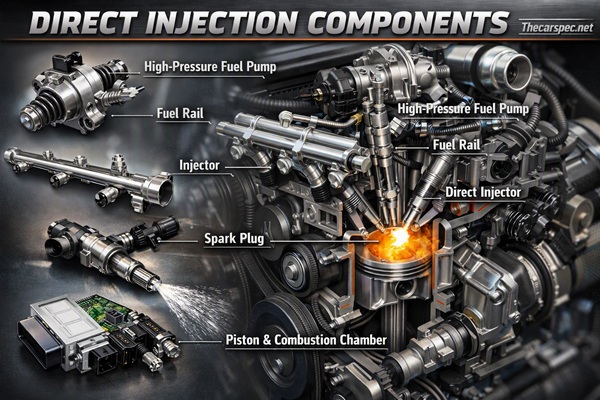
A DI system includes several specialized components engineered to withstand extreme pressures:
- High‑Pressure Fuel Pump (HPFP): Driven by the camshaft, it boosts fuel pressure to DI levels.
- Injectors: Precision multi‑hole injectors designed for exact spray patterns.
- Fuel Rail: A high‑pressure manifold feeding the injectors.
- ECU & Sensors: Control injection timing, pressure, and spray strategy.
- Low‑Pressure Pump: Supplies fuel from the tank to the HPFP.
Each component must operate flawlessly to maintain DI’s advantages.
🧩 Different Types of Direct Injection
- Gasoline Direct Injection (GDI)
Used in most modern gasoline engines. Offers high efficiency and strong performance.
- Diesel Direct Injection
Diesel engines have always used DI, but modern common‑rail systems have dramatically increased pressure and precision.
- Stratified Charge Injection
Used in lean‑burn engines. Fuel is concentrated near the spark plug for ultra‑efficient combustion.
- Homogeneous Direct Injection
Fuel is evenly mixed throughout the chamber, similar to port injection but with DI precision.
- Dual Injection (Port + Direct)
Many manufacturers (Toyota, Lexus, Hyundai, Porsche) combine DI and port injection to reduce carbon buildup and improve flexibility.
🏎️ Direct Injection in Performance Cars
DI has become a cornerstone of modern performance engineering. Here are a few examples:
- Mazda Skyactiv‑G: High compression ratios enabled by DI.
- Volkswagen EA888: Turbocharged DI delivering strong torque and efficiency.
- Ferrari F154 V8: DI allows high boost and incredible power density.
- Porsche 911 Carrera engines: DI improves throttle response and mid‑range torque.
In racing, DI is used in endurance engines to improve fuel economy without sacrificing power—critical in events like Le Mans.
🧪 How DI Enhances Combustion Efficiency
DI allows engineers to control:
- Spray angle
- Droplet size
- Injection timing
- Injection duration
- Multiple injection events
This results in:
- Cleaner combustion
- Lower emissions
- More torque
- Better fuel economy
- Reduced knock
- Higher power density
For enthusiasts, this means engines that feel sharper, more responsive, and more alive.
❤️ Why Enthusiasts Love Direct Injection
Direct injection isn’t just about numbers—it’s about feel.
DI engines deliver:
- Strong low‑end torque
- Crisp throttle response
- Cooler intake temps for better performance
- High‑rev stability
- Compatibility with turbocharging
It’s a technology that blends engineering precision with emotional driving pleasure.