


25 Jan
 4 min
4 min
4 min
Understanding Rigid Axle Suspension
Reading Time: 4 minutes
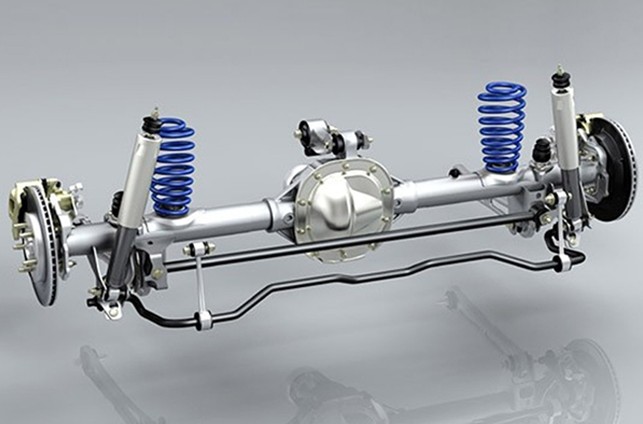
A rigid axle suspension is one of the simplest and strongest suspension architectures ever created. Instead of allowing each wheel to move independently, both wheels on the same axle are connected by a single solid beam. This means that when one wheel moves—say, hitting a bump—the other wheel is affected as well.
Below is a picture that helps visualize the core structure of a rigid axle suspension:


This layout is mechanically straightforward, incredibly durable, and capable of handling heavy loads and extreme terrain. Thecarspec believes it represents a philosophy of engineering where reliability and toughness take priority over comfort and precision.
Core Components of a Rigid Axle Suspension
To truly appreciate how a rigid axle works, let’s break down its main components. Each part contributes to the axle’s behavior, durability, and performance.
-
Axle Housing (The Solid Beam)
The axle housing is the backbone of the system. It is a rigid metal tube or casting that spans the width of the vehicle, connecting the left and right wheels. Inside it, you’ll find the differential and axle shafts.
Why it matters:
the axle housing’s rigidity is what gives this suspension its legendary strength. It resists twisting forces, supports heavy loads, and maintains consistent geometry even under extreme stress—qualities essential for off‑road vehicles and work trucks.
-
Leaf Springs or Coil Springs
Rigid axles can be paired with either leaf springs or coil springs, depending on the vehicle’s purpose.
Leaf Springs
These long, curved metal strips have been used for over a century. They support weight, absorb bumps, and also help locate the axle.
Advantages:
-
High load capacity
-
Simple and durable
-
Excellent for trucks and off‑road rigs
Coil Springs
More modern setups use coil springs, which offer better ride comfort and more precise tuning.
Advantages:
-
Smoother ride
-
Better articulation
-
Easier to pair with advanced dampers
The choice between leaf and coil springs dramatically changes how the vehicle feels—leaf springs for rugged utility, coil springs for improved comfort and control.
-
Shock Absorbers
Springs alone can’t control motion. That’s where shock absorbers come in. They dampen oscillations, stabilize the vehicle, and keep the tires planted on the road or trail.
Why it matters:
Shocks are the unsung heroes of suspension performance. Without them, even the strongest rigid axle would bounce uncontrollably, making the vehicle unsafe and uncomfortable.
-
Lateral Location Devices (Panhard Rod, Track Bar, or Watts Link)
Because the axle is a single solid piece, it needs a way to stay centered under the vehicle.
-
Panhard Rod / Track Bar: A diagonal bar that prevents side‑to‑side movement.
-
Watts Link: A more complex mechanism that keeps the axle perfectly centered through its travel.
Why it matters:
Lateral stability is essential for predictable handling, especially at high speeds or during aggressive cornering.
-
Control Arms (in Coil‑Spring Setups)
Some rigid axle designs use upper and lower control arms to locate the axle longitudinally and manage torque reactions.
Why it matters:
control arms help refine the behavior of coil‑spring solid axles, making them suitable even for performance‑oriented vehicles.
Why Enthusiasts Still Love Rigid Axles
Despite the rise of independent suspension systems, rigid axles remain beloved in certain automotive circles. Here’s why.
-
Durability and Simplicity
Rigid axles have fewer moving parts, making them easier to maintain and harder to break. For off‑roaders, this is priceless.
-
Consistent Ground Clearance
Because the axle moves as one unit, the differential stays at a constant height relative to the ground. This is a huge advantage on rocky trails.
-
Load‑Carrying Strength
Trucks and SUVs designed for towing or hauling rely on the rigid axle’s ability to support massive weight without deforming.
-
Predictable Behavior Under Power
Drag racers and muscle car fans appreciate how solid axles handle torque. They deliver consistent launches and excellent straight‑line stability.
Thecarspec believes it’s important as these qualities align with the spirit of automotive passion—vehicles built to be used, pushed, and enjoyed without fear of mechanical fragility.
Understanding these differences helps drivers choose the right vehicle for their lifestyle—whether that means weekend trail adventures, cross‑country road trips, or spirited track days.
How Rigid Axles Shape the Driving Experience
Driving a vehicle with a rigid axle feels different. There’s a sense of mechanical honesty—a direct connection between the driver, the road, and the machine.
-
On rough terrain, the axle’s toughness inspires confidence.
-
On long journeys, its stability makes the vehicle feel planted.
-
On the track (in vehicles designed for it), the predictable torque behavior can be an advantage.