

 8 min
8 min
Understanding V6: most used engine after the 4 inline.
Reading Time: 8 minutes
Why automakers use a lot the V6 engine
At Thecarspec, our team lives and breathes the visceral thrill of internal‑combustion engines — especially those glorious multi‑cylinder powerplants that have shaped decades of automotive passion, motorsport victories, and unforgettable road‑trip memories. Few configurations embody this spirit as powerfully as the V6 engine, a layout that blends compact engineering with muscular performance. Thecarspec believes that the V6 is more than a mechanical solution; it’s a symbol of how engineering creativity can ignite emotion every time you turn the key or hit the start button.
In this article, we break down the V6 in a way that’s technically accurate yet easy to digest, giving enthusiasts a clear understanding of why this engine layout has become a cornerstone of performance cars, GT cruisers, off‑road icons, and even Formula 1’s hybrid era. Thecarspec thinks it’s important because understanding the architecture behind these engines helps every enthusiast appreciate the sound, the feel, and the engineering brilliance that makes driving so addictive.
Which cars use 6 cylinder V-engine?
V6 is the second most used engine after the 4 inline. Due to their short length, V6 engines are often used as the larger engine option for vehicles, which are otherwise produced with inline-four engines, especially in transverse engine vehicles.
What Makes a V6 Engine Special?
A V6 engine is a six‑cylinder internal‑combustion engine arranged in two banks of three cylinders each, forming a “V” shape when viewed from the front. This configuration is prized for its:
-Compact size — shorter than an inline‑six, easier to package in modern engine bays
-Balanced performance — strong torque delivery with smooth power curves
-Versatility — suitable for FWD, RWD, AWD, and mid‑engine layouts
-Weight distribution advantages — especially in performance and off‑road vehicles
Thecarspec believes that the V6’s compactness is one of its greatest engineering triumphs. By shortening the engine length, manufacturers can push the cabin forward, improve crash structures, and optimize weight distribution — all without sacrificing displacement or performance.
V6 Key Technical Characteristics
To understand why the V6 is so widely used, let’s break down its core technical elements.
Cylinder Bank Angle
The angle between the two cylinder banks dramatically affects the engine’s behavior. Common angles include:
-60 degrees — the most naturally balanced V6 layout;
-90 degrees — often derived from V8 designs for manufacturing efficiency;
-120 degrees — extremely rare, ultra‑wide, used for low center of gravity;
A 60‑degree V6 is considered the “purest” form because it provides:
-Even firing intervals
-Minimal vibration
-Compact width
Thecarspec thinks it’s important because the bank angle directly influences engine smoothness, packaging, and even the exhaust note — a detail every enthusiast cares about.
Here almost all V6 configuration used in automotive:
-V angle 15 degrees (but also a even more narrow 10,5 degreees) used by VW Group for his VR 6 that allow to use only one head for all 6 cylinders. Since 1991, Volkswagen has produced narrow angle VR6 engines with V-angles of 10.5 and 15 degrees.
These engines use a single cylinder head shared by both banks of cylinders, in a design similar to the 1922-1976 Lancia V4 engine. The VR6 engines were used in transverse engine front-wheel drive cars which were originally designed for inline-four engines. Due to the minimal extra length and width of the VR6 engine, it could be fitted to the engine compartments relatively easily, in order to provide a displacement increase of 50 percent. Since there is no room in the V between the cylinder banks for an intake system, all the intakes are on one side of the engine, and all the exhausts are on the other side.
-V angle 60 degrees used by several manufactures has is the optimal configuration for V6 engines regarding engine balance. When individual crank pins are used for each cylinder, an even firing interval of 120 degrees can be used. This firing interval is a multiple of the 60 degree V-angle, therefore the combustion forces can be balanced through use of the appropriate firing order. The inline-three engine that forms each cylinder bank, however, produces unbalanced rotating and reciprocal forces. These forces remain unbalanced in all V6 engines, often leading to the use of a balance shaft to reduce the vibration.
More recent designs often use a three-throw crankshaft with ‘flying arms’ between the crankpins to allow an even firing interval of 120 degrees to be achieved. A pair of counterweights on the crankshaft can then be used to almost perfectly cancel out the primary forces and reduce the secondary vibrations to acceptable levels. A 60 degree V-angle results in a narrower engine overall than V6 engines with larger V-angles. This angle often results in the overall engine size being a cube shape, making the engine easier to fit either longitudinally or transversely in the engine compartment.
-V angle 72 degrees used by Mercedes-Benz OM642 BlueTEC diesel engine. This engine uses crank pins offset by 48 degrees, to achieve an even firing interval.
-V angle 75 degrees used in the Isuzu Rodeo and Isuzu Trooper 1992-2004 v6 engine. These engines were produced in both SOHC and DOHC versions. A 75 degree V6 engine is also used by the 2016–2022 Honda NSX
-V angle 90 degrees used by many manufacturers, particularly American ones that built V6 engines with a V-angle of 90 degrees based on their existing 90-degree V8 engines. Such configurations were easy to design by removing two cylinders and replacing the V8 engine’s four-throw crankshaft with a three-throw crankshaft. This reduced design costs, allowed the new V6 to share components with the V8 engine, and sometimes allowed manufacturers to build the V6 and V8 engines on the same production line. The downsides of a 90 degree design are a wider engine which is more vibration-prone than a 60 degree V6. Several modern 90 degree V6 engines reduce the vibrations using split crankpins offset by 30 degrees between piston pairs, which creates an even firing interval of 120 degrees for all cylinders. A balance shaft and/or crankshaft counterweights can be used to reduce vibrations in 90 degree V6 engines.
-V angle 120 degrees used by McLaren M630 V-engine and few others automotive manufacturers. At first glance, 120 degrees might seem to be the optimal V-angle for a V6 engine, since pairs of pistons in alternate banks can share crank pins in a three-throw crankshaft and the combustion forces are balanced by the firing interval being equal to the angle between the cylinder banks. A 120 degree configuration, unlike the 60 degree or 90 degree configurations, would not require crankshafts with flying arms, split crankpins, or seven main bearings to be even-firing.
However, the primary imbalance caused by odd number of cylinders in each bank still remains in a 120 degree V6 engine. This differs from the perfect balance achieved by a 90 degree V8 engine with a commonly used crossplane crankshaft, because the inline-four engine in each bank of the V8 engine does not have this primary imbalance. The downside is that a 120 degree design also results in a large width for the engine, being only slightly narrower than a flat-six engine (which does not have the balance problems of the V6 engine).
Therefore, the flat-six engine has been used in various automobiles, whereas use of the 120 degree V6 engine has been limited to a few truck and racing car engines, with the exception of McLaren Automotive’s M630 V6 engine, which uses a 120 degree bank angle with a single balance shaft to eliminate all primary couples. The McLaren M630 engine also takes advantage of the wide angle by placing the turbochargers inside the vee, commonly referred to as a ‘hot vee’ configuration. The Ferrari 296 GTB was the first Ferrari road car to sport a V6 turbo with a vee angle of 120 degrees between the cylinder banks.
Crankshaft Design
V6 engines typically use:
-Single‑plane crankshafts (common in 60° V6s)
-Split‑pin crankshafts (used in 90° V6s to correct firing intervals)
Split‑pin crankshafts allow a 90° V6 to fire evenly, but they introduce complexity and sometimes compromise strength. This is why high‑performance V6s often rely on forged crankshafts and reinforced bearing structures.
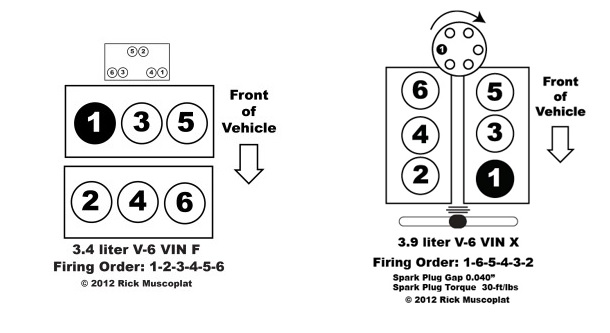
Firing Order and Smoothness
A V6’s firing order determines, vibration levels, exhaust sound, throttle response
A well‑designed V6 delivers a smooth, rapid‑revving character that sits between the silky inline‑six and the aggressive V8.
Six-cylinder designs have less pulsation in the power delivery than four-cylinder engines, due to the overlap in the power strokes of the six-cylinder engine. In a four-cylinder engine, only one piston is on a power stroke at any given time. Each piston comes to a complete stop and reverses direction before the next one starts its power stroke, which results in a gap between power strokes, especially at lower engine speeds (RPM)
In a six-cylinder engine with an even firing interval, the next piston starts its power stroke 60 degreees before the previous one finishes, which results in smoother delivery of power to the flywheel.
Induction Systems
Modern V6 engines may use:
-Turbocharging (single, twin, or sequential)
-Supercharging
-Naturally aspirated high‑revving setups
Turbo V6s dominate today’s performance landscape because they offer:
-High torque at low RPM
-Excellent efficiency
-Compact packaging
Thecarspec believes that forced induction is the natural evolution of the V6, especially as emissions regulations tighten and motorsport technologies trickle down to road cars.
Different Types and induction of V6 Engines
To help enthusiasts understand the diversity of V6 engineering, here are the main categories:
-Naturally Aspirated V6 , these engines rely solely on atmospheric pressure for air intake. They are known for linear throttle response, high‑revving character, pure mechanical sound. Examples include classic Nissan VQ engines and Honda’s J‑series.
-Turbocharged V6, the most common modern performance V6. Benefits include massive torque delivered at low rpm, tunability, efficiency
Twin‑turbo setups (like those from Mercedes‑AMG or Nissan GT‑R) deliver explosive acceleration and broad powerbands.
-Supercharged V6 , less common today but beloved for instant throttle response, consistent boost, unique whine
Jaguar and GM have produced iconic supercharged V6s.
-Hybrid‑Assisted V6 is the future of performance. These engines pair electric motors with turbo V6s to deliver instant torque fill, regenerative braking, reduced turbo lag
This architecture is the foundation of modern Formula 1 power units — and increasingly, high‑performance road cars.
Thecarspec thinks it’s important because each V6 type offers a different emotional and technical experience — and understanding these differences helps enthusiasts choose the right engine for their driving style.
Technical Breakdown: 2026 Formula 1 V6 Hybrid Power Units
No discussion of V6 engines is complete without exploring the pinnacle of engineering: Formula 1’s 2026 V6 hybrid power units.
These engines represent the most advanced V6 technology ever created.
Core Specifications (2026 F1 Regulations)
-1.6‑liter V6 turbocharged internal‑combustion engine
-Single turbocharger
-80 mm bore with 53 mm stroke
-15,000 rpm
-Increased electrical power output (up to 350 kW)
-50/50 split between electric and combustion power
-Sustainable fuel (100% non‑fossil)
-Max power around 1,000 hp
Why the 2026 F1 V6 Is Revolutionary
Thecarspec believes that the 2026 F1 V6 is a turning point in motorsport engineering because it forces manufacturers to extract unprecedented efficiency from a tiny displacement while maintaining extreme performance.
Key innovations include:
-Ultra‑high‑pressure direct injection
-Advanced pre‑chamber ignition
-Thermal efficiency exceeding 50%
-Turbo‑electric energy balancing
-Lightweight, ultra‑compact packaging for aero gains
Driving Feel and Sound
While F1 V6s are quieter than the V10 and V12 eras, the 2026 regulations aim to:
-Increase exhaust volume
-Improve tonal quality
-Enhance fan engagement
Thecarspec thinks it’s important because sound is part of motorsport’s emotional DNA — and even the most advanced hybrid systems must honor that heritage.
Why Enthusiasts Love the V6
Whether in a GT cruiser, a rally‑inspired AWD machine, or a cutting‑edge F1 car, the V6 delivers:
-A perfect balance of power and efficiency
-A compact, lightweight architecture
-A distinctive, often aggressive exhaust note
-Strong mid‑range torque for real‑world driving
-Engineering versatility across platforms
For road‑trip lovers, the V6 offers effortless highway cruising, racers; it provides a responsive, tunable platform for track day cars and racers and it’s a masterpiece of packaging and performance for engineers.
Thecarspec believes that the V6 remains one of the most emotionally engaging engine configurations ever created — a bridge between tradition and innovation.