

 5 min
Top 5 Most Reliable Gasoline Car Engines
Reading Time: 5 minutes
The 5 Most Reliable Gasoline Car Engines: Proven Durability in a Changing Automotive World
Over the last decade, gasoline engines have undergone one of the biggest transformations in automotive history. Manufacturers have reduced displacement, introduced turbocharging, improved fuel injection systems, and adopted advanced engine management technologies to meet increasingly strict emissions regulations. At the same time, electrification has expanded across the industry, leading many enthusiasts to wonder whether the golden age of internal combustion engines was coming to an end.
Despite the rapid growth of hybrid and electric vehicles, gasoline-powered cars have remained a dominant force in the United States. While EV sales continue to rise, millions of drivers still appreciate the simplicity, long-distance capability, and proven durability of traditional gasoline engines. Modern powerplants deliver more horsepower, consume less fuel, and produce fewer emissions than ever before. However, among all these technological advancements, reliability remains one of the most important factors for car buyers.
A reliable engine is more than a technical achievement. It represents peace of mind, lower maintenance costs, and confidence during every journey. Whether you are commuting daily, taking long road trips, or enjoying a spirited drive on your favorite back road, an engine that can withstand hundreds of thousands of miles is worth its weight in gold.
Today, we’re looking at five gasoline engines that have earned a legendary reputation for durability, longevity, and engineering excellence. These engines have consistently demonstrated outstanding reliability across real-world driving conditions and continue to be admired by enthusiasts worldwide.
-
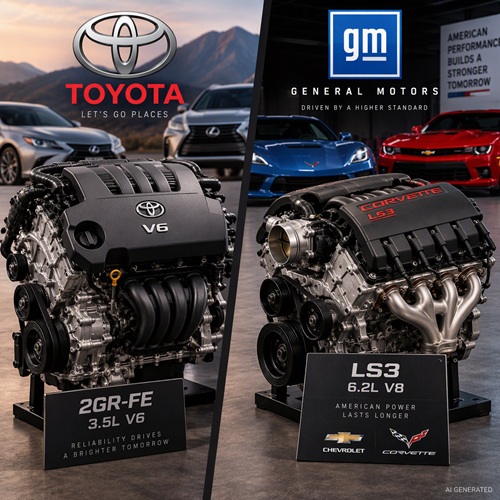
Toyota 2GR-FE 3.5L V6
When discussing reliability, Toyota inevitably becomes part of the conversation. One of the company’s finest achievements is the 2GR-FE V6 engine.
Introduced in the mid-2000s and continuously refined over the years, this naturally aspirated 3.5-liter V6 became a staple across the Toyota and Lexus lineup. It can be found in models such as the Toyota Camry, Avalon, Highlander, Sienna, and several Lexus vehicles.
Producing between 268 and over 300 horsepower depending on the application, the 2GR-FE combines smooth power delivery with exceptional durability. Unlike many modern engines that rely heavily on turbocharging, the Toyota V6 maintains a relatively simple design philosophy.
Owners frequently report mileage well beyond 250,000 miles with only routine maintenance. Common repairs are generally minor and inexpensive compared with many competitors.
What makes this engine so dependable?
- Strong aluminum block construction
- Proven timing chain design
- Efficient cooling system
- Conservative engineering approach
- Excellent manufacturing quality control
For drivers seeking a combination of refined performance and long-term reliability, the Toyota 2GR-FE remains one of the best gasoline engines ever produced.
-
Honda K24 2.4L Inline-Four
Few engines have earned the respect of car enthusiasts quite like Honda’s K-Series family. Among them, the K24 stands out as one of the most reliable four-cylinder engines of the modern era.
Used extensively in the Honda Accord, CR-V, Element, and Acura TSX, the K24 became famous for delivering a rare combination of efficiency, responsiveness, and durability.
One of Honda’s greatest strengths has always been precision engineering, and the K24 showcases this philosophy perfectly. Its robust bottom end, excellent oiling characteristics, and durable timing chain system contribute to a remarkably long service life.
Many examples have surpassed 300,000 miles while retaining excellent compression and driving characteristics.
Enthusiasts appreciate the K24 not only for its reliability but also for its tuning potential. It has become a favorite platform for performance builds, proving that durability and excitement can coexist.
Key strengths include:
- Bulletproof internal components
- Low maintenance requirements
- Excellent fuel economy
- Strong aftermarket support
- Proven long-term durability
For many enthusiasts, the Honda K24 represents the perfect balance between practicality and driving enjoyment.
-
Lexus/Toyota 1UZ-FE 4.0L V8
Although it debuted before the last decade, the legendary 1UZ-FE deserves recognition because its reputation remains unmatched even today.
Originally developed for the Lexus LS luxury sedan, the 1UZ-FE was engineered with extraordinary attention to detail. Toyota reportedly designed this engine to compete directly with the finest German luxury powertrains while delivering superior dependability.
The result was a remarkably smooth and durable aluminum V8 capable of accumulating enormous mileage.
Many owners have documented examples exceeding 500,000 miles with proper maintenance. In fact, the engine became so respected that it found applications in motorsports, off-road vehicles, boats, and custom performance projects around the world.
What made it special?
- Forged internal components on early versions
- Exceptionally balanced design
- High-quality materials throughout
- Outstanding thermal management
- Minimal mechanical weaknesses
Even years after production ended, the 1UZ-FE remains a benchmark for reliability in the automotive industry.
-
Mazda Skyactiv-G 2.5L Inline-Four
Mazda has followed a unique path in an era dominated by downsized turbocharged engines. Rather than focusing exclusively on smaller displacement and forced induction, Mazda invested heavily in refining naturally aspirated engine technology.
The Skyactiv-G 2.5-liter engine is perhaps the best example of this philosophy.
Found in vehicles such as the Mazda6, CX-5, CX-50, and CX-9 in some markets, the engine combines high compression ratios with sophisticated combustion technology.
Despite its advanced engineering, the Skyactiv-G remains remarkably reliable. Its simplicity compared with many turbocharged competitors helps minimize potential failure points.
Owners consistently praise the engine for:
- Smooth operation
- Excellent fuel efficiency
- Low maintenance costs
- Strong longevity
- Reliable daily performance
Thecarspec believes that the Skyactiv-G demonstrates how intelligent engineering can enhance efficiency without compromising durability.
For drivers who value reliability and driving engagement, Mazda’s Skyactiv approach continues to be one of the most compelling solutions on the market.
-
General Motors LS3 6.2L V8
No list of reliable gasoline engines would be complete without mentioning a member of GM’s legendary LS family.
The LS3, a naturally aspirated 6.2-liter V8 found in vehicles such as the Chevrolet Corvette and Camaro SS, has earned widespread praise for its durability and performance.
One reason for its popularity is its relatively straightforward pushrod architecture. While some may view this design as old-fashioned compared with modern dual-overhead-cam engines, the simplicity of the LS3 contributes significantly to its reliability.
The engine delivers impressive power while maintaining excellent serviceability.
Advantages include:
- Robust iron and aluminum component design
- Fewer moving parts than many competitors
- Strong aftermarket support
- Proven track record in performance applications
- Excellent longevity under proper maintenance
Performance enthusiasts often push LS engines to extraordinary power levels, yet stock examples are fully capable of accumulating hundreds of thousands of miles.
Thecarspec thinks it’s important because reliability should not require sacrificing driving excitement. The LS3 proves that an engine can deliver thrilling performance while maintaining the durability expected from a daily-driven vehicle.
Why Reliability Still Matters
Modern automotive technology continues to evolve rapidly. Hybrid systems, electric vehicles, advanced driver-assistance systems, and connected technologies are transforming the driving experience. Yet the importance of engine reliability remains unchanged.
A dependable engine reduces ownership costs, increases resale value, and allows drivers to focus on enjoying their vehicles rather than worrying about unexpected repairs. Reliability also reflects the quality of engineering behind a vehicle, demonstrating how effectively manufacturers balance performance, efficiency, and durability.
The five engines featured here represent different philosophies and engineering approaches.
Toyota prioritizes consistency and refinement.
Honda emphasizes efficiency and precision.
Lexus showcases extraordinary craftsmanship.
Mazda focuses on intelligent innovation.
GM demonstrates the enduring strengths of simplicity and performance.
Together, these engines highlight an essential truth: the best powerplants are not always the most complex or the most powerful. Often, the greatest engines are those that continue to start every morning, perform reliably for hundreds of thousands of miles, and provide years of driving enjoyment.
For true automotive enthusiasts, reliability is not boring. It is a hallmark of exceptional engineering. And these five gasoline engines have earned their place among the most respected and dependable powerplants ever built.