

 4 min
Hybrid vs Plug-In Hybrid: Key Differences, Benefits, and Which One Is Right for You
Reading Time: 4 minutes
Hybrid vs Plug-In Hybrid: Understanding the Technology Behind Today’s Most Efficient Cars
Over the last decade, gasoline engines have undergone one of the most significant transformations in automotive history. Manufacturers have developed smaller yet more powerful turbocharged engines, advanced direct fuel injection systems, variable valve timing technologies, and highly sophisticated engine management software. These innovations have allowed modern gasoline-powered vehicles to deliver more power while consuming less fuel than their predecessors.
At the same time, automakers have accelerated the development of electrified powertrains. The American market has embraced this trend enthusiastically, with hybrid and plug-in hybrid vehicle sales growing rapidly as consumers seek lower fuel costs without sacrificing practicality. Industry sales data shows that hybrid models continue to gain market share across nearly every vehicle segment, particularly SUVs and family cars, while plug-in hybrids are attracting buyers who want electric driving capability without the range concerns often associated with fully electric vehicles. [greencars.com], [goodcarbadcar.net]
For car enthusiasts, this evolution is fascinating. Electrification is no longer just about fuel economy. It is about improving performance, responsiveness, refinement, and everyday usability.
So, what exactly is the difference between a Hybrid (HEV) and a Plug-In Hybrid (PHEV)? Let’s dive into the technical details.
What Is a Hybrid Vehicle (HEV)?
A Hybrid Electric Vehicle (HEV) combines a conventional gasoline engine with one or more electric motors and a relatively small battery pack.
Unlike an electric vehicle, a hybrid does not need to be plugged into an external power source. The battery is recharged automatically through:
- Regenerative braking
- Energy recovery during deceleration
- The gasoline engine itself
The electric motor assists the gasoline engine during acceleration and can power the vehicle independently for very short distances and at low speeds.
The primary goal of a hybrid system is to improve efficiency while maintaining the convenience of a traditional gasoline vehicle.
Typical HEV Components
- Gasoline engine
- Electric motor
- High-voltage battery
- Power control unit
- eCVT or dedicated hybrid transmission
When the vehicle starts moving, the electric motor often does most of the work. During stronger acceleration, both the gasoline engine and electric motor operate together. This combination helps reduce fuel consumption while delivering smooth and immediate acceleration.
What Is a Plug-In Hybrid Vehicle (PHEV)?
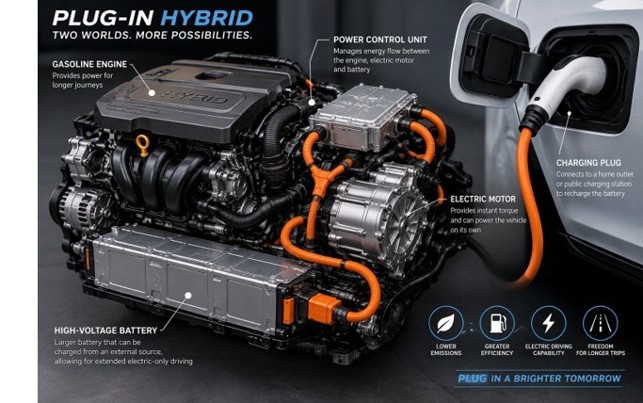
A Plug-In Hybrid Electric Vehicle (PHEV) uses a similar architecture but includes a much larger battery that can be charged externally from a home outlet or charging station.
This larger battery allows the vehicle to travel substantial distances using electricity alone before the gasoline engine is required.
Many modern PHEVs offer between 30 and 50 miles of all-electric driving, enough to cover the average daily commute for many drivers. The Toyota RAV4 Plug-in Hybrid (formerly RAV4 Prime), for example, offers approximately 42 miles of electric range before operating as a traditional hybrid. [autoedgeview.com]
Typical PHEV Components
- Gasoline engine
- One or more electric motors
- Large high-voltage battery
- On-board charging system
- Regenerative braking system
A plug-in hybrid can essentially function as:
- An electric vehicle for short trips.
- A hybrid vehicle for longer journeys.
This flexibility explains why many automotive enthusiasts consider PHEVs one of the most practical solutions currently available.
Technical Comparison: Hybrid vs Plug-In Hybrid
| Feature | Hybrid (HEV) | Plug-In Hybrid (PHEV) |
| External charging | No | Yes |
| Battery size | Small | Large |
| Electric-only driving | Limited | Extensive |
| Fuel economy | Excellent | Exceptional when charged regularly |
| Vehicle weight | Lower | Higher |
| Purchase price | Usually lower | Usually higher |
| Long-distance travel | Excellent | Excellent |
| Daily electric commuting | Limited | Outstanding |
From a technical perspective, the major difference is battery capacity.
A conventional hybrid typically uses batteries between 1 and 2 kWh. Plug-in hybrids often use batteries between 10 and 20 kWh or more. Toyota’s RAV4 Plug-in Hybrid uses an 18.1-kWh battery pack. [autoedgeview.com]
Thecarspec believes that the choice between a Hybrid and a Plug-In Hybrid depends less on technology and more on how you use your vehicle every day.
Drivers covering long highway distances may benefit from the simplicity and efficiency of a conventional hybrid. Meanwhile, drivers with short daily commutes and access to home charging can dramatically reduce fuel consumption with a plug-in hybrid.
How Regenerative Braking Works
One of the most fascinating aspects of both HEVs and PHEVs is regenerative braking.
In traditional vehicles, braking converts kinetic energy into heat.
In electrified vehicles, the electric motor works as a generator during deceleration, converting kinetic energy into electricity and storing it in the battery.
Benefits include:
- Reduced brake wear
- Higher overall efficiency
- Improved energy recovery
- Better fuel economy
This technology is a major reason hybrids achieve such impressive efficiency ratings.
The 3 Best-Selling Hybrid Vehicles in the United States
Based on recent U.S. market trends, these models rank among the strongest-selling hybrid vehicles in America.
-
Toyota RAV4 Hybrid
One of America’s most popular SUVs, combining practicality, reliability, and efficiency. Hybrid versions account for a significant portion of total RAV4 sales. [goodcarbadcar.net], [greencars.com]
Thecarspec Link:
https://www.thecarspec.net
-
Honda CR-V Hybrid
The CR-V Hybrid utilizes Honda’s advanced two-motor hybrid architecture producing up to 204 horsepower and excellent fuel economy. [hondanews.com], [honda.ca]
Thecarspec Link:
https://www.thecarspec.net/honda/cr-v
-
Toyota Prius
The Prius remains one of the most recognizable hybrid vehicles ever built, achieving up to 57 MPG combined in certain configurations. [toyota.com], [toyota.com]
Thecarspec Link:
https://www.thecarspec.net/toyota/prius
The 3 Best-Selling Plug-In Hybrid Vehicles in the United States
-
Jeep Wrangler 4xe
The Wrangler 4xe has become one of America’s most successful PHEVs by combining off-road capability with electric driving functionality.
Thecarspec Link:
https://www.thecarspec.net/jeep/wrangler-4xe
-
Toyota RAV4 Plug-In Hybrid (RAV4 Prime)
A benchmark among PHEVs thanks to its strong performance and approximately 42 miles of electric driving range. [autoedgeview.com]
Thecarspec Link:
https://www.thecarspec.net/toyota/rav4-plug-in-hybrid
-
Chrysler Pacifica Plug-In Hybrid
One of the most practical plug-in hybrids available, combining family-focused versatility with meaningful electric-only capability.
Thecarspec Link:
https://www.thecarspec.net/chrysler/pacifica-plug-in-hybrid
Performance Benefits Most People Don’t Expect
Many drivers assume electrified vehicles are designed only for fuel economy.
That is no longer true.
Electric motors produce maximum torque instantly.
This means:
- Faster initial acceleration
- More responsive throttle inputs
- Smoother power delivery
- Better city-driving performance
Modern hybrid systems can actually improve the driving experience compared to conventional gasoline-only vehicles.
A great example is the latest Toyota Prius, producing up to 194 horsepower while delivering outstanding fuel economy. [thecarconnection.com], [toyota.com]
Which Technology Is Right for You?
Choose a Hybrid (HEV) if:
- You drive long distances frequently.
- You cannot recharge at home.
- You want maximum simplicity.
- You prioritize reliability and fuel savings.
Choose a Plug-In Hybrid (PHEV) if:
- You can charge regularly.
- Your daily commute is relatively short.
- You want the benefits of EV driving without range anxiety.
- You want greater flexibility.
Final Thoughts
The automotive industry is experiencing one of the most exciting engineering revolutions ever seen. Hybrid and Plug-In Hybrid technologies are no longer compromises. They are highly sophisticated solutions that blend efficiency, performance, and practicality in ways that would have seemed impossible just a decade ago.
For enthusiasts, understanding how these systems work reveals the remarkable engineering hidden beneath the bodywork. For everyday drivers, they provide a smarter and more efficient way to enjoy the freedom of the open road.
Whether you choose a Hybrid or a Plug-In Hybrid, there has never been a better time to experience the world of electrified performance.